

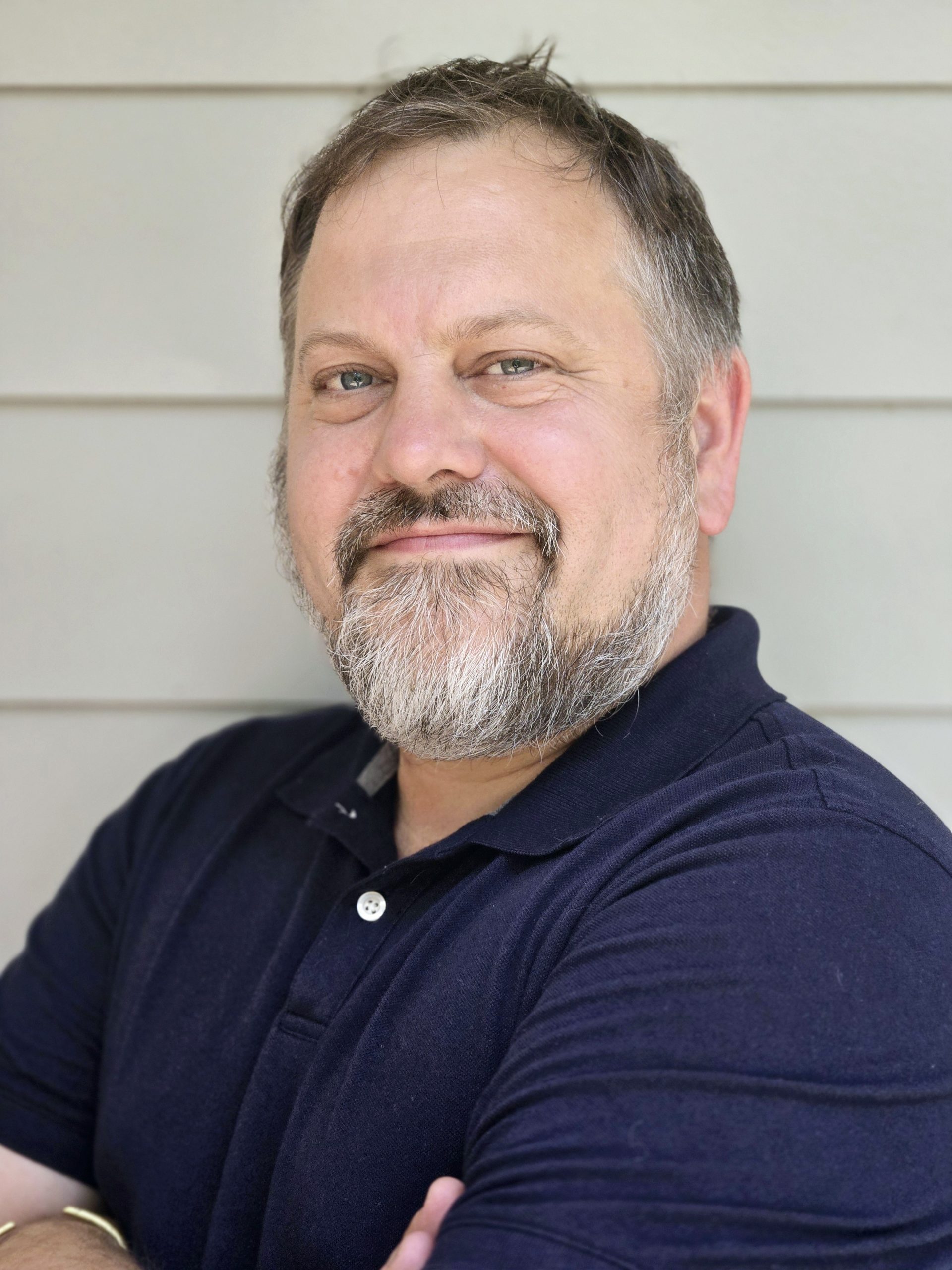
Full name: Wes McMahon
Party affiliation: Democrat
Campaign website: www.wesforchapelhill.com
1) In 300 words or less, please give our readers your elevator pitch: Why are you running? Why should voters entrust you with this position? What prior experience will make you an effective member of the Chapel Hill town council?
I’m Wes, a husband, father of two public school children, and a dedicated civic volunteer for the eleven years we have made Chapel Hill home.
My professional and volunteer experience has uniquely prepared me to address our town’s challenges. I have worked with refugees and immigrants at the national and local level, which has taught me to meet people where they are and center services in their lived experience. Advocating for better state gun laws on the board of North Carolinians Against Gun Violence (NCGV) taught me how to push new policy amidst public health trauma and political division.
I have firsthand knowledge of town operations through my service on two commissions. While serving on the Parks, Recreation, and Greenways Commission, I learned how essential it is to fund free programs that are equitable and ensure everyone can live a healthy life. I am now in my third year on the Planning Commission, where I weigh tough decisions that balance growth with community needs and environmental protection.
Chapel Hill leads with strong values—a place for those who strive for diversity, equity, and inclusion. We are also an increasingly expensive place to live. Our workforce is often priced out and rising property taxes strain lower income families and those on fixed incomes. We must also face emerging impacts of climate disruption and how we balance new housing without causing more harm to downstream neighbors living in flood prone areas.
Working together is the only way to meet these challenges while upholding our values amid growing budget constraints. I am running because I am a connector with a track record of bringing people together around the issues they care about. My years of civic engagement have prepared me to be the kind of informed and responsive decision-maker Chapel Hill needs now.
2) What would your priorities be as a member of the Chapel Hill town council? Please identify three of the most pressing issues Chapel Hill currently faces and how you believe the town should address them.
Chapel Hill faces three urgent challenges: securing our fiscal future, tackling the affordability crisis, and building the parks and greenways our residents deserve.
We’re facing a tough financial reality: less money is coming in, but our costs are going up. We can’t keep kicking the can down the road and raising residential property taxes that make it even less affordable for lower income residents to live here. I am committed to narrowing our priorities and making tough choices on spending. I will push to get the data we need to make evidence-based decisions with our budget. Our efforts will be tracked, measured, and focused on delivering the results we want to see. Second, we must fuel our future by building a stronger, more diverse financial engine. That means an urgent push to boost our commercial tax base, grow sales tax revenue, and bring in private investment through smart public-private partnerships. The fastest way to achieve all of this is to build smart. We will strategically zone for denser, multi-family housing along our main transit corridors in areas that won’t create additional flooding threats to downstream neighbors.
The evidence of our affordability crisis is clear. Our school system has lost 1,300 students over the last five years and we see 40,000 commuters come to work in Chapel Hill each day. I can’t accept the fact that Chapel Hill is no longer a place where families and our workforce can call home. On the Planning Commission, I have been proud to work with developers to lower the size of new housing units so they are naturally more affordable. I will immediately champion the Complete Community Strategy, starting with the long-awaited pilot project at Midtown with UNC. This strategy is our roadmap to build diverse, accessible housing and create walkable neighborhoods that benefit everyone.
It is time to catch up with our neighboring communities and build the parks and greenways our residents deserve for mental, physical, and environmental health. We currently have a $30 million park maintenance backlog and have seen very little of our greenway network built. I will fast-track the creation of new greenways and move quickly to temporarily restore those damaged by Chantal. My focus is on smart, lower-cost solutions—like finding alternative routes to those that aren’t funded and quickly completing small, high-impact sections that connect historically underserved neighborhoods. As a park advocate for over ten years, I’m ready to hit the ground running. When the Parks and Recreation Master Plan is completed next year, I will prioritize delivering a healthy Chapel Hill for all. We can start with lower-cost projects using our existing staff and facilities, but we’ll also aggressively seek private investment to fill the gaps left by reduced federal funding, ensuring that every corner of our town has equal access to high-quality public spaces.
3) What’s the best or most important thing the Chapel Hill Town Council has done in the past year? Additionally, name a decision you believe the town should have handled differently. Please explain your answers.
The most important recent action by the Town Council was passing the 100-year stormwater requirement. This is a necessary step to mitigate potential harm to downstream neighbors from new developments. The next step is to better engage our stormwater staff to answer important questions that council and residents need to make informed decisions to balance our town’s goals but also prevent doing more harm. In Chapel Hill, we value taking care of those who are most at risk. We can’t allow our ambitious housing goals to push more water and more costs onto existing homeowners.
I believe the Town Council should have addressed the budget shortfall differently. The recent tax increase was too much, too fast. While some increase is needed to account for inflation, this significant jump unfairly burdened our residents who are struggling the most. Before asking taxpayers to cover an increase in spending, the Town Council and staff should have first exercised real due diligence. They needed to actively find ways to re-allocate funds and cut spending. They could have also waited a year to better understand how looming federal funding cuts will impact our programs and the livelihoods of federal employees. I look forward to working with our new Town Manager to implement strong, data-driven budgeting. We must narrow our focus, manage our finances sustainably, and earn the public’s confidence in our fiscal leadership.
4) President Trump is working to ramp up deportations and curtail visas. At the same time, the state legislature has passed laws requiring agencies to cooperate with ICE. What do you think Chapel Hill can or should do to ensure safe, welcoming communities for immigrants in light of these policies?
It’s clear our federal and state governments are replacing funding with fear. I have seen the devastating pain of family separation firsthand, and I will not let that trauma take hold here. We must do everything in our power to keep families together. If someone in our community faces deportation, we must immediately activate a caring safety net. This means engaging community partners to help relatives sustain their lives and ensure children stay in school, safe and supported. We will affirm our community policing model, which focuses on public health and safety while strictly adhering to the law and the Constitution. Let me be clear: we will not assist in executing unlawful warrants for ICE to enter our schools, homes, or places of worship. Our strategy is to be vigilant, not complicit. We will strengthen partnerships with other law enforcement agencies to better understand potential activities, who might be targeted, and the detention process. Crucially, we must continue to educate both our businesses and residents on their Fourth Amendment rights and empower targeted communities to mitigate potential harm. We will keep Chapel Hill safe, caring, and united.
5) Faced with federal funding cuts, rising costs, and a revaluation that saw home values skyrocket, the town council (in a 5-4 vote) approved a $164 million budget funded by the fifth tax increase in as many years. For current council members, please explain how you voted and why. For non-incumbents, please explain how you would have voted and why.
I would not have voted for the recent tax increase.
While addressing deferred maintenance and staff compensation is vital, the primary responsibility lies with the staff and Council to find ways to make difficult financial decisions that minimize the impact on residents. With the cost of living soaring and many in our community facing job uncertainty due to cuts at universities, hospitals, and non-profits, we cannot rely on significant residential property tax hikes. We must recognize that we are in an uncertain time, and the town and region will likely face further federal funding cuts. Therefore, we should have been more cautious. I believe we should have paused the proposed spending levels for staff pay and deferred maintenance, as more information on the long-term financial picture will become available later this year.
6) The town has prioritized climate action and climate resiliency, but the catastrophic flooding from Tropical Storm Chantal shows that the town and its residents continue to be vulnerable to these disasters. How can Chapel Hill best help impacted residents and prepare for future disasters? How should the council deal with the coal ash at the police station, which has been impacted by separate flood incidents?
When Chantal hit, I didn’t wait. I delivered emergency supplies to a devastated complex, then instantly organized volunteers to haul trash, move appliances, and provide hands-on relief. This gave me an opportunity to see the damage firsthand, discuss concerns with residents, and put my networks into action. To prepare for future disasters, the number one thing we can do is invest in solutions that provide results. This starts with an updated stormwater plan that integrates both traditional infrastructure and green solutions, clearly specifying the level of mitigation each measure provides. For some high-risk residents, the best option may be to relocate. We should actively consider all solutions that may include helping people move out of repeatedly flooded areas. We must also address storm water management with new development and clearly answer the question if the project will reduce, increase, or make no change to downstream neighbors. We should not be creating additional problems for communities that flood and not oppose new housing that experts agree will not create additional risks. Finally, the Town must significantly improve communication with residents before, during, and after extreme weather events. I want a thorough after-action review with public participation. This open review is essential for understanding what the Town did and didn’t do well and is necessary to build public trust.
I believe the Town is moving in the right direction on coal ash at Bolin Creek. We’ve secured a new location for the police station that prioritizes public health and follows the science—a commitment that should always guide our strategic goals. It is equally important that we do not simply relocate all our coal ash to burden other communities. I support the approach suggested by the EPA and DEQ: a model of selective removal and capping at the current site. We must execute our Brownfields agreement to prepare this location for future appropriate use, such as a municipal services center, and in the meantime much-needed space for parks and recreation activities like pickleball, basketball, or other outdoor uses. This path allows us to address a complicated environmental legacy while safeguarding the health of our residents and preparing for the Town’s future needs.
7) As with most places in the Triangle, Chapel Hill is grappling with a shortage of affordable housing. How should the town address housing affordability over the next few years?
Our first step is to immediately modernize our zoning laws to align them with our community vision, making sure we build smart housing where it’s needed most. These new rules will be designed to incentivize affordable, smaller-scale housing like I have recommended on the Planning Commission. We must launch our first Complete Community pilot project right away. This is how we bring UNC to the table as a key partner, providing housing that their own employees can afford. In this era of reduced revenue, we must be smart with our resources. We should ask staff to prioritize high-impact, lower-cost actions from our affordable housing plan and get to work on those priorities. For example, I could imagine recruiting more private investment to grow our revolving loan fund may be an achievable goal staff could highlight in this process. To provide housing for our lowest-income neighbors, we must support our non-profit partners to accelerate construction on pipeline projects, including the Greene Tract, Legion Road, and Hillside Trace.
7) Last year, the council voted to eliminate several advisory boards and commissions. How can the town best improve its community engagement process, especially to reach residents who do not have the time or resources to attend town council meetings on weekday nights?
I don’t just talk about community engagement; I live it. After Chantal, I jumped in to help affected residents and organized volunteers to join me in the effort. When a neighbor reached out on our listserv to voice concern with Town response, I met with her and connected her to resources and engaged other neighbors on how to petition Town Council. During tough budget debates, I personally hosted a neighborhood meeting with the mayor to bring questions and get direct answers on taxes. I regularly read emails to the town and reach out to individuals to learn more and provide support. I’ve been on the ground, connecting residents with resources as a citizen, and I’ll bring that same spirit of active service to the Town Council. We must do a much better job of getting out into the community instead of just expecting people to come to us. We already know that traditional formats, like speaking at a council meeting, pose intimidating barriers for many people. We also didn’t see results from offering reimbursement for childcare and transportation. I believe that policy failed because it requires residents to pay for these services upfront—another barrier for lower-income families. We need the Town Manager to implement a new framework and ensure we see results within the year. We can explore using apps to connect with busy, young, and non-native English speakers as phones offer reasonable translation. We can experiment with short, engaging captioned videos—like the successful content our library staff is already creating. Ultimately, we must reach out and listen to the voices that aren’t being heard right now to understand what solutions will work for them.
8) The Orange County commission is responsible for levying taxes to fund Chapel Hill-Carrboro City Schools (CHCCS). That said, what role (if any), should the town council play in supporting CHCCS given the school district’s ongoing budget issues and threatened federal grant cuts?
Bringing this question closer to home, I find it unacceptable that our state government refuses to pass a budget, so teacher pay raises are delayed. While the amount we pay our teachers is hardly enough, denying them approved raises while the cost of living is up is a direct insult. Our Town Council must relentlessly advocate for passing the state budget now to get this critical money out of state coffers and directly into teacher pockets. I have to give a huge shout-out to our PTAs and their tireless volunteers. They carry a heavy load of filling critical funding gaps in our schools, and they are key partners as we address these ongoing financial shortfalls. The Town of Chapel Hill has effective ways to support our kids and we need to double down on them. We must continue to excel at coordinating community-level partnerships to ensure our children have access to after-school and summer camp opportunities, and keep our crucial food-for-student program running strong. I had the opportunity to work on a grant for the Safe Routes to School program as a commission member, and we must continue to build bike lanes and greenways, install high-visibility crosswalks, and support our crossing guards to get our children to school safely. Finally, we must urgently build more housing suitable for families. Bringing back enrollment levels is vital for school funding, and it creates vibrant, family-friendly communities that are good for all residents.
9) UNC is a major employer and landholder in Chapel Hill. How would you rate the relationship between the university and the town? What would you like to see change?
We need to continue building our mutually beneficial partnership. The reality is UNC owns a larger portion of our land in town and doesn’t contribute property taxes to help run the town the UNC-CH calls home. We need the University to invest in other ways to ensure we have a vibrant Chapel Hill, not just for residents, but also for the students and employees who make the university run. Chapel Hill residents treasure Carolina North as a vital green space in the heart of our town, and there’s understandable anxiety about what and how UNC will develop there. The only way forward is through good-faith partnership with the University. Whatever they build at Carolina North must be done with the Town and with genuine respect for surrounding residents. The recent state legislation seeking to exempt state projects from our local zoning is a step in the wrong direction of building trust. We have seen UNC partner well, however, on projects like the Innovate Carolina Junction and our successful fare-free transit collaboration. I am committed to leveraging this progress to help UNC partner on our Complete Community pilot project at Midtown, which is a critical step toward meeting our shared housing goals.
10) If there are other issues you want to discuss, please do so here.
No one enjoys turning on the news right now. Amidst the growing uncertainty and fear our federal and state governments are creating at their level, it’s time for our Town Council to fiercely focus on what we can control: providing a safe, prosperous place right here at home. This isn’t naive optimism; it is a necessity. When our state, federal government, and climate disruption create chaos, working together in unity is the only way forward and the only way to make sure that our most vulnerable neighbors are safe. The people of Chapel Hill are looking for local leaders who will instill confidence and earn trust, so that when everything seems impossible, we can stand together and genuinely believe “We’ve got this.” This is the focus and the energy I will bring to our Town Council, and I invite everyone to join me in this essential work.
Comment on this story at [email protected].